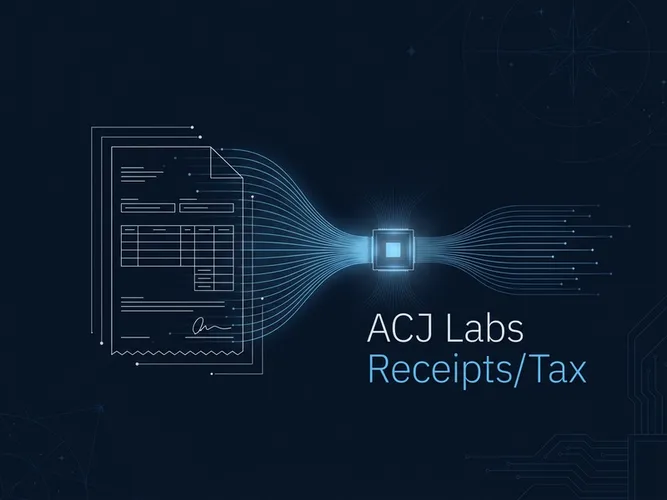
The GST rule your receipt scanner doesn't know exists

The GST rule your receipt scanner doesn't know exists

A restaurant receipt and a client dinner look identical to an OCR tool. Under Australian GST rules, they aren’t: entertainment expenses have their input tax credit (ITC) denied by default — GST was charged, but the business can’t claim it back — and nothing printed on the receipt tells you that.

Most receipt scanners stop at “find the vendor and the total.” Ours classifies each line against the actual rules. A ribeye and a glass of shiraz at a steakhouse come back entertainment_denied, with a rationale like “entertainment ITC denied, no exception context.” An in-flight meal on an interstate business flight comes back taxable under the recognised incidental-to-travel exception, with a rationale like “meal incidental to business travel.” Same-looking meal, different rule, tax-coded and explained either way.

Every line carries the tax_code, a confidence score, and that one-line rationale naming the rule — so you (or your accountant) can check the call instead of trusting a black box. ABN checksum validation is built in too.

Try Receipt Extraction →

This reflects publicly documented Australian tax law and is provided as software output, not tax advice.
Related Posts

A wrong ABN and a smudged one look the same to OCR. We made sure ours doesn't guess.

A wrong ABN and a smudged one look the same to OCR. We made sure ours doesn't guess.

Every Australian Business Number carries a checksum — a modulus-89 formula baked into the digits themselves, so a wrong ABN is usually mathematically detectable, not just "looks a bit off." Which…

read more
Build vs. buy: should your bookkeeping tool parse receipts with a raw LLM call?

Build vs. buy: should your bookkeeping tool parse receipts with a raw LLM call?

Here's the honest version of the pitch first: if all you need is vendor, date, and total off a receipt, you should probably build it yourself. A single vision-model call — GPT-4o-mini, Gemini Flash…

read more
Choosing a product categorization API: five questions that separate grounded from guessing

Choosing a product categorization API: five questions that separate grounded from guessing

If you're mapping a product feed to the Google Product Taxonomy, you have more options than you did a year ago — a raw LLM call, a handful of categorization APIs, a feed tool with categorization…

read more
Choosing a receipt extraction API: six questions that separate tax-aware from just-OCR

Choosing a receipt extraction API: six questions that separate tax-aware from just-OCR

Here's the honest version of the pitch first: if all you need is vendor, date, and total off a receipt, you should probably build it yourself. A single vision-model call — GPT-4o-mini, Gemini Flash…

read more
How to integrate the catalog attribute normalizer MCP server

How to integrate the catalog attribute normalizer MCP server

This guide covers the mechanical integration steps for the catalog-attribute-normalizer MCP server: client configuration, authentication, and tool usage, so you can normalize product catalogs against…

read more
How to integrate the ACJ Labs receipt extraction MCP server

How to integrate the ACJ Labs receipt extraction MCP server

This guide covers the mechanical integration steps for the ACJ Labs receipt extraction MCP server: client configuration, authentication, schema definitions, and error handling, so you can consume the…

read more
x402 Bazaar Listing Monitor: catch a vanished listing before your revenue does

x402 Bazaar Listing Monitor: catch a vanished listing before your revenue does

If you sell over x402, your buyers find you through Coinbase CDP's Bazaar discovery catalog. It's the directory that lets an agent or a buyer's client discover your payTo address and the resources…

read more
How accurate is "just ask the model to categorize it"? We measured — 1–2 of 12 checks.

How accurate is "just ask the model to categorize it"? We measured — 1–2 of 12 checks.

If you're mapping a product catalog into Google's Product Taxonomy, the obvious first move is to hand the title and description to a capable model and ask for the category. It reads well in a demo.…

read more
AI product classifiers hand you category IDs that don't exist. Here's how we stopped ours.

AI product classifiers hand you category IDs that don't exist. Here's how we stopped ours.

Ask a capable AI model to classify a product into Google's Product Taxonomy and it will do something unsettling: return an ID that looks completely valid — right format, plausible category name — and…

read more